Key takeaways
- $1.5 billion raised across Series B ($1.1B) and pre-Series C SAFE ($433M) in 2025, with approximately $1.7 billion raised to date including earlier funding rounds.
- Reported contracts for 200,000 NVIDIA GB300 GPUs with Microsoft across four facilities.
- Estimated $14 billion total contract value with Microsoft as anchor customer.
- Company-stated 100% renewable energy operations leveraging Norwegian hydroelectric and Arctic cooling.
- 1.3 GW stated pipeline would require an estimated approximately 20x scale-up from current 30MW operational capacity (expanding to 60MW by Q2 2025).
While American hyperscalers race to build trillion-dollar AI empires, a just 2-year-old London-headquartered startup closed $1.5 billion in funding and reportedly signed contracts to deploy 200,000 NVIDIA GPUs across continents. NScale isn't trying to compete with Microsoft or Amazon; it's aiming to build the infrastructure they appear to need but may not be able to deploy fast enough.
The company's playbook is ambitious: leverage Europe's renewable energy advantage, seek to secure preferential GPU allocations from NVIDIA, and position itself as an essential infrastructure partner for hyperscalers constrained by power grids and permitting delays. With a reported $3 billion valuation and ambitions for a potential IPO, NScale could represent either a highly strategic infrastructure play in Europe's AI buildout or a case study in the challenges of scaling rapidly in capital-intensive markets.
For investors evaluating European AI infrastructure opportunities, the question isn't whether NScale is growing; it's whether this velocity is sustainable.
The infrastructure gap creating neoclouds
Europe faces what appears to be a significant supply-demand mismatch in AI compute. Industry analyses estimate co-location facilities contributed significantly to economic activity in 2023, with forecasts suggesting substantial growth by 2030. European data centre power demand reportedly hit an estimated 96 TWh in 2024 and is projected to reach 168 TWh by 2030, a 75% increase in six years.
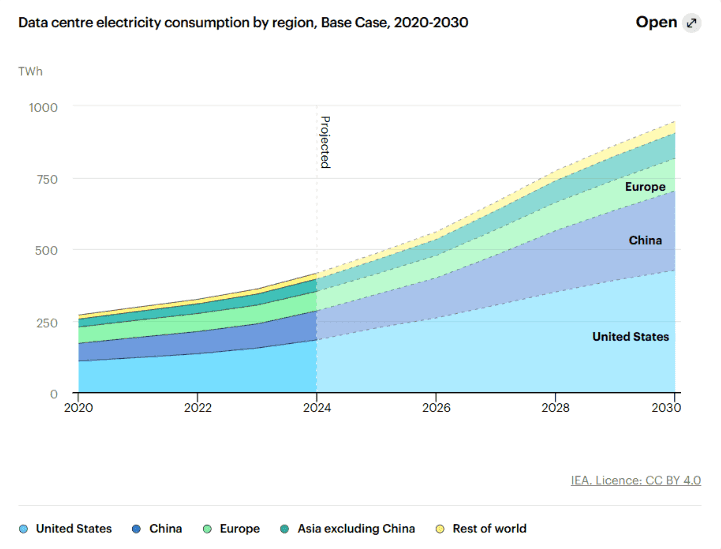
But traditional hyperscalers appear unable to build fast enough to meet current demand. Grid interconnection queues reportedly extend up to seven years in some key markets. Europe's data centre pipeline also represents substantial capacity requirements, placing significant pressure on the region's power infrastructure.
This constraint has birthed the "neocloud" opportunity: specialised GPU providers seeking to fill the gap between what hyperscalers need and what they can deploy, including NScale.
NScale financial snapshot: Capital intensity meets anchor contracts
The company suggests its renewable energy cost advantages could provide meaningful margin improvements compared to grid-dependent competitors. According to industry analyses, gross profit margins for GPU rental businesses may be in the mid-teens after labor, power costs, and depreciation, meaning any cost advantage could be significant. In this thin-margin environment, maintaining high utilisation rates and stable pricing is critical.
Metric | Figure | Context |
Total Capital Raised | $1.7 Billion (reported) | $1.5B in 2025 rounds plus earlier funding |
Current Valuation | $3.0 Billion (reported) | Post-Series B (September 2025) |
Operational Capacity | 60 MW (company-stated) | Glomfjord, Norway facility |
Pipeline Capacity | 1.3 GW (company-stated) | Would require significant infrastructure capex |
Sources: Company announcements, CNBC, Data Center Dynamics, TechCrunch, Financial Times
Microsoft: a key customer
According to company disclosures and press reports, contracts with Microsoft cover approximately 104,000 NVIDIA GB300 GPUs for a 240MW facility in Texas from Q3 2026, 52,000 GPUs in Narvik Norway, 12,600 GPUs in Portugal from Q1 2026, and 23,000 GPUs in Loughton UK from Q1 2027. Combined, this would represent a significant proportion of NScale's revenue, a notable concentration risk.
Why would Microsoft, a hyperscaler with substantial capital resources, outsource capacity to a relatively new startup? Likely factors appear to include speed and capital efficiency. Building 240MW of AI data centre capacity from grid connection to operation reportedly takes traditional operators several years. Microsoft appears to face substantial demand from Azure customers and OpenAI that internal buildout may not satisfy quickly enough. Neoclouds may provide strategic overflow capacity.
The principal risk? If Microsoft builds sufficient internal capacity by 2027-2028, NScale's anchor revenue could face pressure. The company's mitigation appears threefold: geographic diversification with U.S. expansion, customer base expansion through OpenAI's exploratory offtake of up to 8,000 GPUs with potential to scale to 31,000 GPUs across UK sites, and moving up-stack from raw compute to managed AI services and orchestration tools.
The Norway advantage: Renewable energy as moat
According to the company, NScale's first operational facility sits in Glomfjord, Norway, powered entirely by 100% hydroelectric energy. The 60MW facility reportedly leverages Arctic Circle temperatures for energy-efficient cooling, with the company stating it has eliminated diesel generators entirely while aiming to provide structural cost advantages over grid-dependent competitors.
This could represent margin engineering rather than greenwashing. While grid-powered competitors may face higher power costs as a percentage of operating expenses, renewable energy sourcing could reduce NScale's power expenses meaningfully. In the thin-margin GPU cloud economics where industry gross margins are estimated to be in the mid-teens, even a modest power cost advantage could compound significantly over multi-year contracts.
The renewable positioning may also provide regulatory advantages. The EU AI Act and related European digital infrastructure initiatives aim to expand regional data centre capacity with streamlined approvals and public funding for energy-efficient facilities.
For investors tracking how AI startup valuations in Europe are accelerating, NScale's trajectory reflects broader regional momentum.
Execution gauntlet: 60MW to 1.3GW
According to company disclosures, NScale's operational capacity is 60MW. Its stated pipeline is 1.3 GW, approximately a 20-fold increase that would require significant infrastructure capex. The company has raised approximately $1.7 billion to date and any gap to fund capex is expected to be filled through project financing backed by Microsoft contracts, a potential IPO and additional equity rounds.
The challenge may not be capital availability; it appears to be operational execution. Data centre development is unforgiving: NVIDIA GPU allocation bottlenecks, grid connection delays can easily add 12-24 months. Any supply chain disruption or construction delay could cascade through revenue realisation timelines.
For context, CoreWeave, NScale's closest U.S. comparable, is trading at a valuation of approximately $50 billion. But CoreWeave faces its own execution challenges: the company revised full-year 2025 revenue guidance amid reports of third-party data centre developer delays, highlighting how external dependencies can derail timelines even for well-capitalised players.
Valuation trajectory: From stealth to IPO candidate
Funding Round | Date | Amount Raised | Post-Money Valuation | Lead Investors |
Series B | Sep 2025 | $1.1 Billion (reported) | ~$3.0 Billion (reported) | Led by Aker, with participation from NVIDIA, Dell, Nokia and others |
Pre-Series C SAFE | Oct 2025 | $433 Million (reported) | ~$3.0 Billion (reported) | Undisclosed |
Sources: Company disclosures, Financial Times, Tech Funding News
The Series B round was reportedly oversubscribed, with Aker's participation reported to represent the industrial conglomerate's largest technology investment.
Vertical integration: ground-to-cloud ownership
A key differentiator from competitors is NScale's vertically integrated model, meaning owning the data centre, GPU cluster, and software stack, rather than relying on third-party colocation providers like many neoclouds. NScale has argued that many neoclouds face structural challenges, leaving them subject to rising colocation fees and capacity constraints for large-scale GPU deployments. This ground-to-cloud approach may provide greater control over power costs, deployment timelines, and the ability to accommodate next-generation high-density AI workloads.
Competitive dynamics and market position
NScale appears to compete in the "sovereign scale" quadrant, positioned between pure-play cost leaders and hyperscaler-integrated platforms. Its differentiation centres on three pillars: GPU availability through strategic relationships with NVIDIA and Dell that may provide preferential allocations; European sovereignty providing UK-headquarters and EU facilities designed to address data residency requirements under GDPR and the EU AI Act; and company-stated 100% renewable energy from Norwegian hydro and UK wind that could create both cost advantages and regulatory compliance.
The competitive threat is coming both from above and below. From below, aggregator platforms, undercutting on price but potentially sacrificing reliability. From above, for example, AWS has announced a European Sovereign Cloud in Germany, while Microsoft deploys custom Azure Maia chips supported by extensive dedicated fibre networks.
If hyperscalers achieve custom silicon parity with NVIDIA GPUs, neoclouds may lose core differentiation. NScale's positioning appears to counter this through sovereign AI workloads requiring physically isolated, EU-domiciled infrastructure where U.S. hyperscalers may face structural regulatory challenges.
The margin reality
GPU cloud economics are challenging. According to industry analyses, gross profit margins for GPU rental businesses may be in the mid-teens after labor, power costs, and depreciation, meaning utilisation shortfalls or pricing erosion can significantly impact profitability. GPU pricing tends to decline materially with each new chip generation, suggesting capital must be recovered relatively quickly to avoid stranded assets.
NScale's business model appears to rely on multi-year anchour tenant contracts providing base load utilisation combined with renewable energy cost advantages. But thin margins may leave limited room for execution error. For investors familiar with the economics of scaling AI applications, the infrastructure layer may face even more unforgiving unit economics than the application layer.
The outlook
NScale appears to represent a significant expression of Europe's AI sovereignty ambitions. The structural demand appears substantial; Goldman Sachs forecasts suggest meaningful growth in Europe's power demand over 10-15 years driven by data centres. But infrastructure businesses typically live or die on execution velocity and margin discipline.
For sophisticated investors evaluating next-generation industries, one perspective is that the opportunity may lie in timing rather than thesis. The next months leading to a potential IPO will likely help determine whether NScale becomes Europe's infrastructure champion or a lesson in ambition outpacing execution.
As AI continues remaking work rather than ending it, the companies providing the essential compute infrastructure may capture significant value. Whether NScale joins that cohort will likely depend on its ability to industrialise data centre deployment at unprecedented velocity while maintaining tight margins, a challenge where in infrastructure, execution is everything.
The information contained in this article is based on publicly available data, including company press releases, statements from company leadership, reports from major financial news outlets (including CNBC, Bloomberg, Financial Times, TechCrunch), and data from private market intelligence platforms. We have not independently verified the data and do not guarantee its completeness or accuracy.
This article is for informational and educational purposes only and should not be construed as investment, financial, legal, or tax advice. It represents our analysis and viewpoint and is not a recommendation to buy, sell, or hold any security. Investing in private, venture-backed companies like NScale involves a high degree of risk, including the risk of complete loss of investment. Past performance, growth, and valuations are not indicative of future results. Any forward-looking statements, including projections regarding future revenue, valuation, capacity expansion, and IPO timelines, are speculative and subject to change. Readers should conduct their own due diligence and consult with a qualified financial advisor before making any investment decisions.
Published by Samuel Hieber